Powered By Blogger
Showing posts with label Drawing. Show all posts

Monday, 14 November 2016

The Importance of Doodling

Were your old school books covered in doodles? Did you draw moustaches on the faces in newspapers as a child? Doodling can be quite therapeutic, but there are some important benefits to doodling.

As a toddler, doodling allows children to express themselves- they learn that their lines and marks can represent a form of communication.

Children (and adults) can think out ideas through doodling. There is no pressure to create something artistic so everyone can access this art.

Last month, I visited a really interesting exhibition in The Stedelijk Museum, Amsterdam. There was an exhibition about the work of Jean Tinguely. It was a really fun exhibition! He enjoyed making machines out of scrap materials to create unique abstract art- or 'doodles'.


He also enjoyed sending some of his own doodles to people- so simple, but so effective.


Doodles would be a fantastic response to Tinguely's work.

It's a fun drawing lesson to explore in primary school, but children may find it difficult to know where to start. Luckily Twinkl have made some free doodling resources for Claire's Primary School Art followers! They have a blank book shelf- this may be handy during Book Week and a blank shop window- may be a nice link with ag siopadóireacht. 

http://www.twinkl.co.uk/resource/roi2-a-20-doodle-draft-shop-front-activity-sheet


If you have any other doodle ideas- it is worth asking Twinkl to create a resource, this is free of charge! What did we ever do without it! :) 

If you're interested in learning more about the benefits of doodling this interesting article highlights how it can be of benefit to your focus and memory!

http://www.wsj.com/articles/the-power-of-the-doodle-improve-your-focus-and-memory-1406675744

Tuesday, 17 November 2015

Line

I have begun some after school art lessons with sixth class. My main focus is to ease the transition to secondary school- giving them a taste of the lessons that they may have if they choose art next year.

I asked some secondary school art teachers for advice and most replied with practice drawing still life objects- they felt that children are so used to making products in primary school that when they come to secondary they are missing a lot of the skills.

http://juliannakunstler.com/art1_ea_line.html#.VkufPBDhDVp

I haven't any formal training in art like secondary school teachers would have, but I'm just giving it a go! However, I did find this website extremely helpful.

Firstly, we began with drawing different types of line. Practising different types of line, with different shades of pencil and varying the intensity of each.


I gave the children some ideas that they may respond with a line.


Then we drew some onions and oranges. The children were encouraged to look and observe- what were they actually seeing in front of them?


Then using 'windows' the children focused in on a small area and enlarged it onto the page.


There was a big focus on looking at the shapes and drawing what they see- not a cartoon version of the objects.

Here's another great idea for creating Optical Illusions with line:
http://juliannakunstler.com/art1_lines.html#.VkuhSBDhDVp

Sunday, 27 September 2015

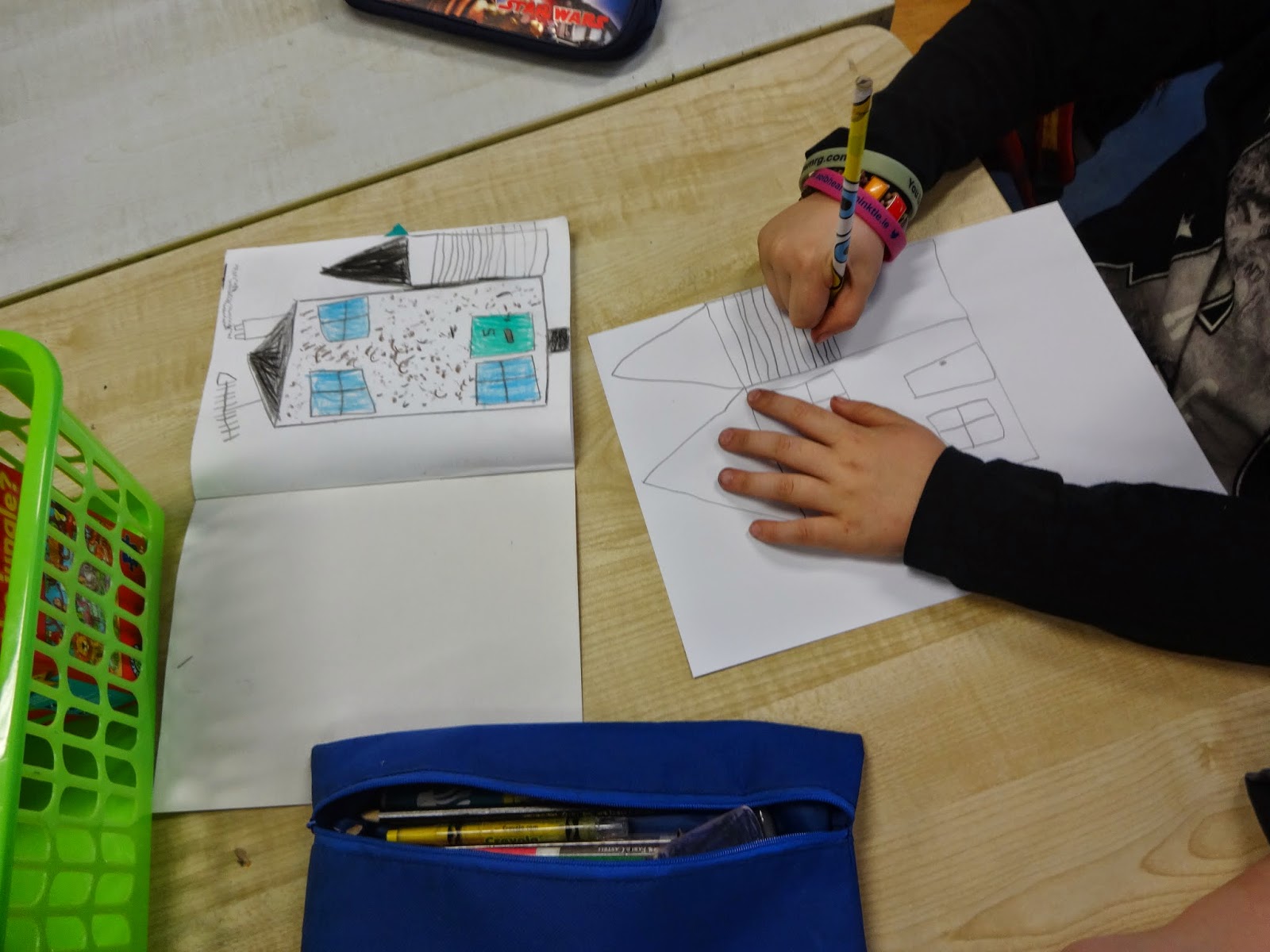
Houses and the emotional meanings


Young children draw the world as they perceive it.

As Gaeilge normally moves to the theme of "Sa Bhaile" in October, the theme of "Houses", "My Home" and "My Family" are more than likely being explored.

Before children learn the skills to draw their house accurately, their drawings may give you a more honest view into how their see their home life. This may be beneficial when drawing up behaviour plans or emotional support in the classroom.

Firstly, the child will spend time drawing the family members they deem important. As a teacher, I always see the child drawing their parent(s), sibling(s) and pet(s).

When the child draws the house, does it look warm and inviting?
Windows and paths are symbolic of the child's feelings of being open. Shut curtains and no paths may indicate being closed towards communicating with others.

Does the house dominate the page? or is it small and in the corner?
This could represent the dominance of home life, or rejection.

I'm not an art therapist, nor am I trained in the area, but I found these posts interesting as we get to know the children in our class further. This is often the time of the year when behaviour problems begin and the child's art may be an insight to the feelings within.

http://www.academia.edu/6520325/House_Tree_Person_Interpretation_Elements

http://www.intelligentietesten.com/house_tree_person_drawings.htm

Wednesday, 19 August 2015

Talking through Drawing

I love this idea! Especially on a day when the energy in the class in high and you want the children to focus again.

http://doodles.typepad.com/thedoodler/leaf-pod-doodles/

Rules-
Only communicate through the drawing.
No planning before- i.e. "we are going to draw ..."


You Will Need-
A piece of paper between each pair
A different colouring pencil in each pair

The children are placed in pairs. A piece of paper is placed between them.

The first child draws a shape. The next  adds another shape to it.

They continue to draw, one at a time- until the page is full.

It is beneficial to discuss the many types of lines before this lesson or as a warm up.
https://www.blendspace.com/lessons/XNz8R4ywMmUXhw/lines

This is a great friendship building lesson as they must work together to create and be in tune with what the other child is trying to create.


Monday, 17 August 2015

What Drawing Materials to Use?

Infants:


Markers and Crayons- These are harder and can stand up to their quicker drawing methods.
Children should be moved to finer point pencils/crayons when they begin to colour neatly and look for them. The larger crayons can be very frustrating to use in smaller areas.

Oil pastels are great to get bright, vibrant colours and are very effective on displays.

There should be a range of paper types and sizes available at this age.

First Class to Fourth:


Soft chalk pastels are suitable to introduce at this stage.

Smudging and blending can be achieved with charcoal. I like to use this on newsprint paper.

Children draw their interests and what they observe at this age.
They use symbols to represent objects ('m' for bird in the sky). It is beneficial to encourage the children to observe what they are drawing at this stage to aid the development of their drawing.

Fourth Class to Sixth:


Drawing skills can be introduced at this stage. (See Previous Post). Children will have been given the opportunity to experiment with different drawing materials and may have preferences.

Other ideas:
Drawing objects one in front of the other.
Objects getting smaller as they are further away.
Objects moving up the page getting smaller as they are further away.

Still Life:
Recognise size difference
Edges of objects
Shadows


Saturday, 15 August 2015

For the child that gets hung up on perfection...

There are some children that are so creative, and others that find the greyness of the subject so daunting.

While I like everything to be 'just so' in my classroom- organised into plastic boxes and zip lock bags- I like the learning to be flexible.

I feel this is so important in school. Learning can be so rigid before college and then we are expected to think outside the box and take leaps of faith in different research topics.

Here are some great ways to help the child looking for perfection to work creatively:

Remove the White Paper

I know the feeling myself- that big sheet of white paper- now how to make a product that looks 'nice'?

Scrap it!

Cut a hole in the paper. It's already ruined...let the creativity begin! 


Or how about removing the white paper altogether?

Painting on newspaper:


Finding a picture in the Abstract


Sketch Books

As I mentioned in a previous post, using sketch books in the classroom was highly beneficial this year. I picked up this sketch book in MoMA- it has fantastic sketch starts.


It's available on Amazon and I highly recommend it! 


Wednesday, 12 August 2015

Drawing Skills

These are some ideas for teaching drawing skills. I'd recommend this from 4th class upwards as this is the age children start to move away from just using art equipment freely and want to learn some skills. I think these lessons keep it fun and interesting!


This book is really helpful for drawing skills ideas.

Drawing Upside Down


This is just a sketch of a tree from a photograph that I did. You could give the children a simple picture, upside down, and they draw it upside down.

Drawing the Four Angles


Turn the object, and draw it from a new angle in a different colour. The final one can be tricky!

Drawing in String


Creating the drawing in string. This was a self-portrait. It enables children to see the contours.

Experiment with a Variety of Materials.


Give the children freedom to experiment with different pencils, charcoal, chalk and oil pastels.

Negative Spaces


Children look at the space in between objects- not the object (this is tricky!) This exercise also encourages the children to use the right hand side of their brain, the creative side. 

This is explained in this book (another favourite!)